You, at the panel
The control surface at http://localhost:8899 — the simple view for the household, the advanced view for you.
First run
What ferrule serve shows before anything is routed.
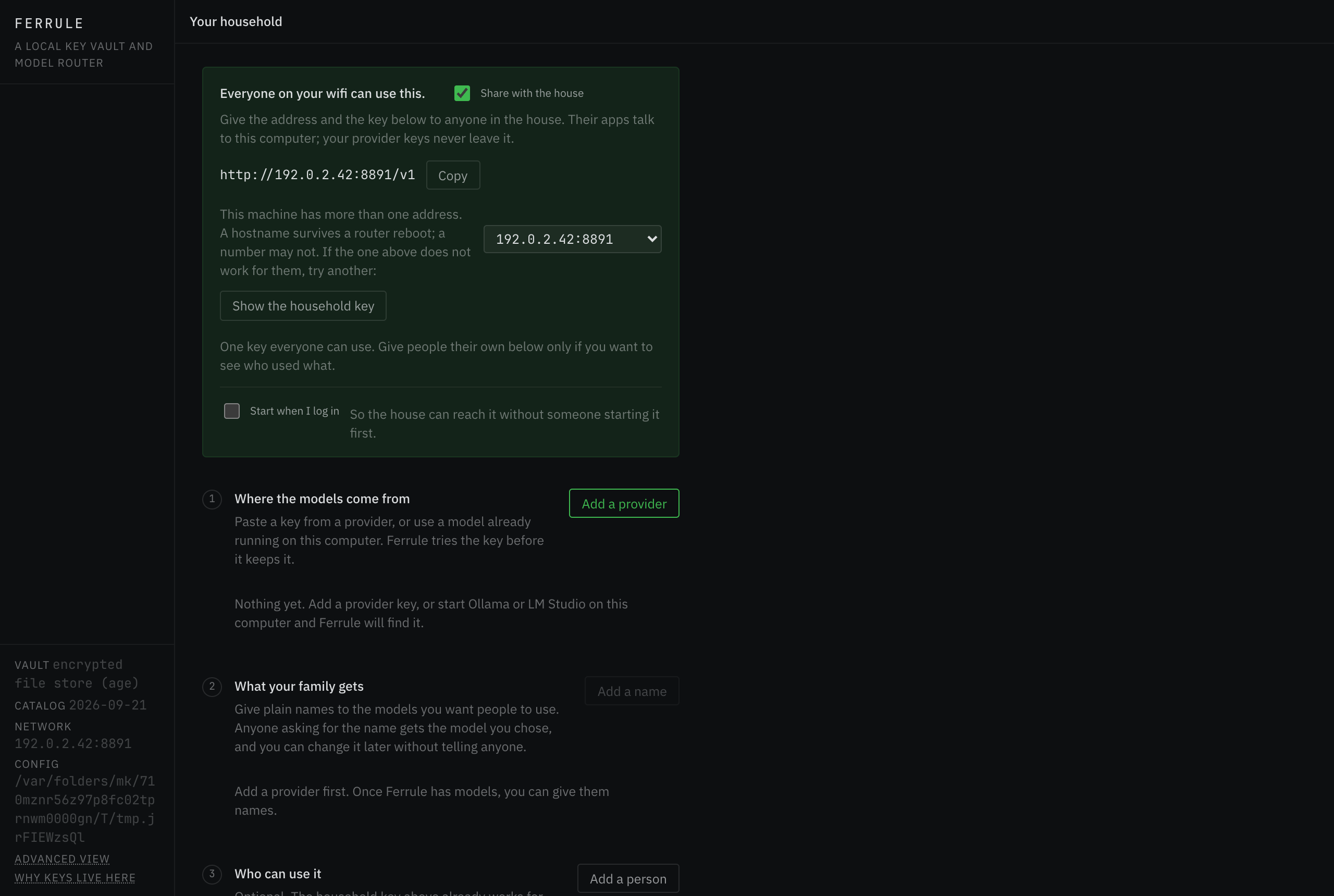
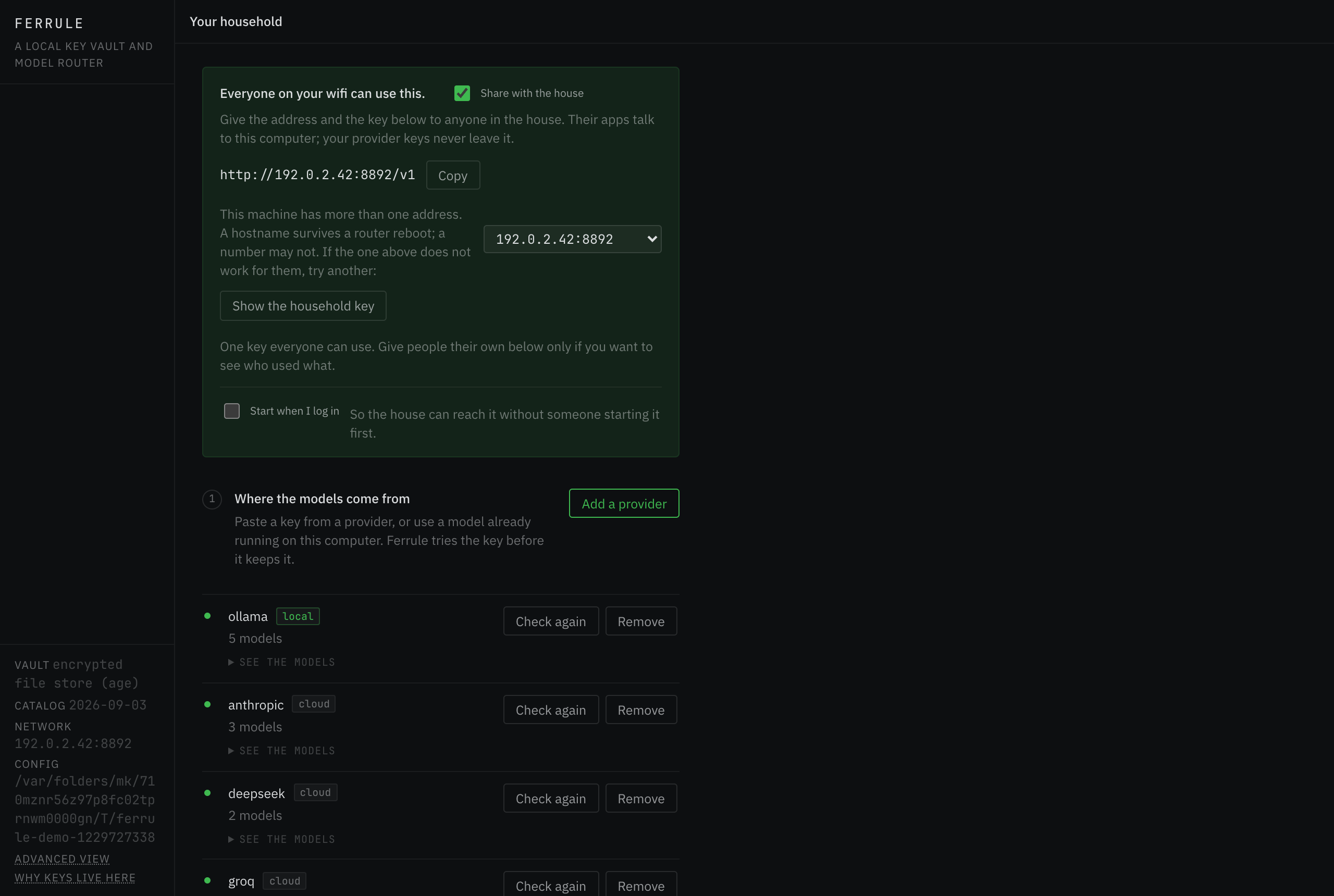
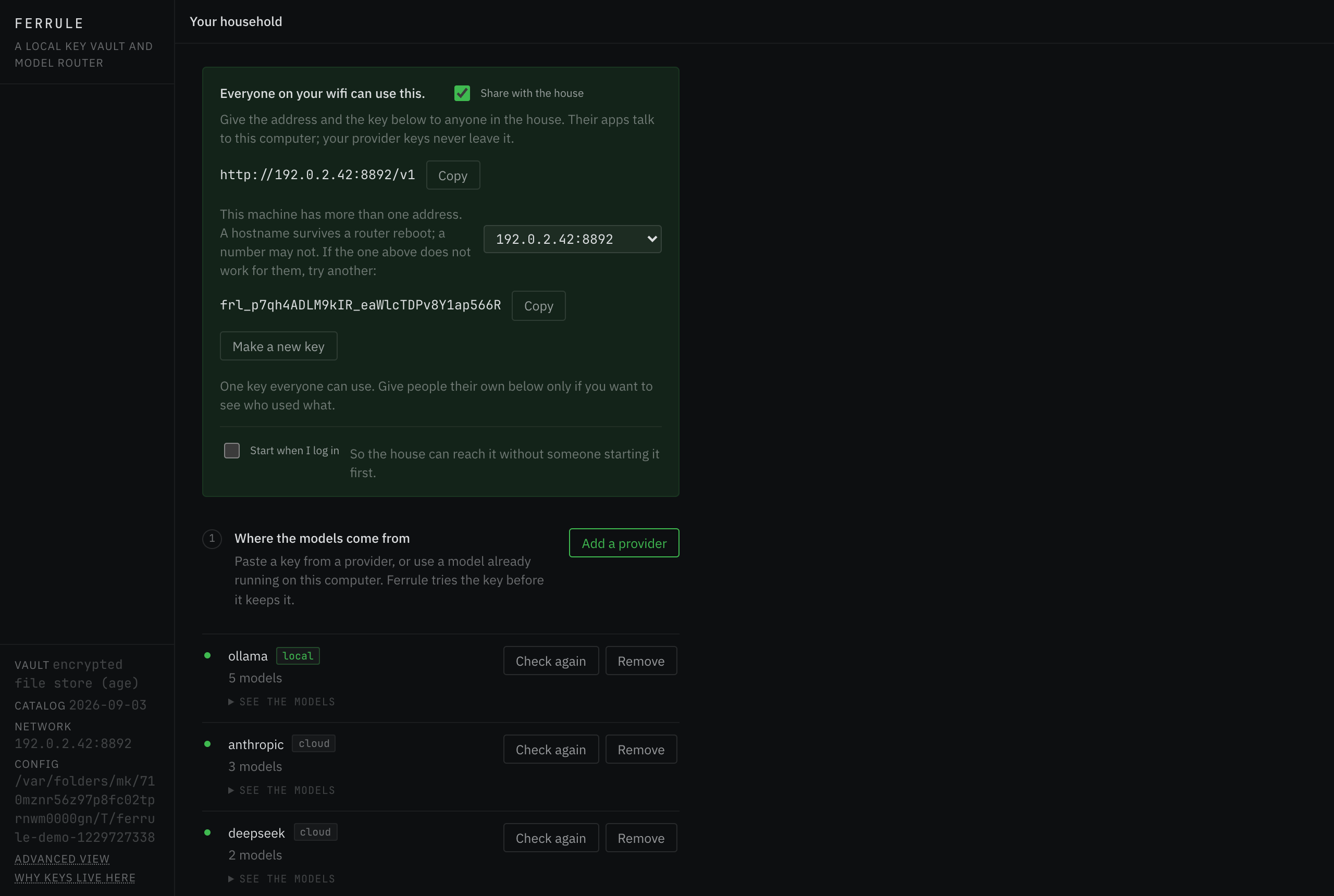
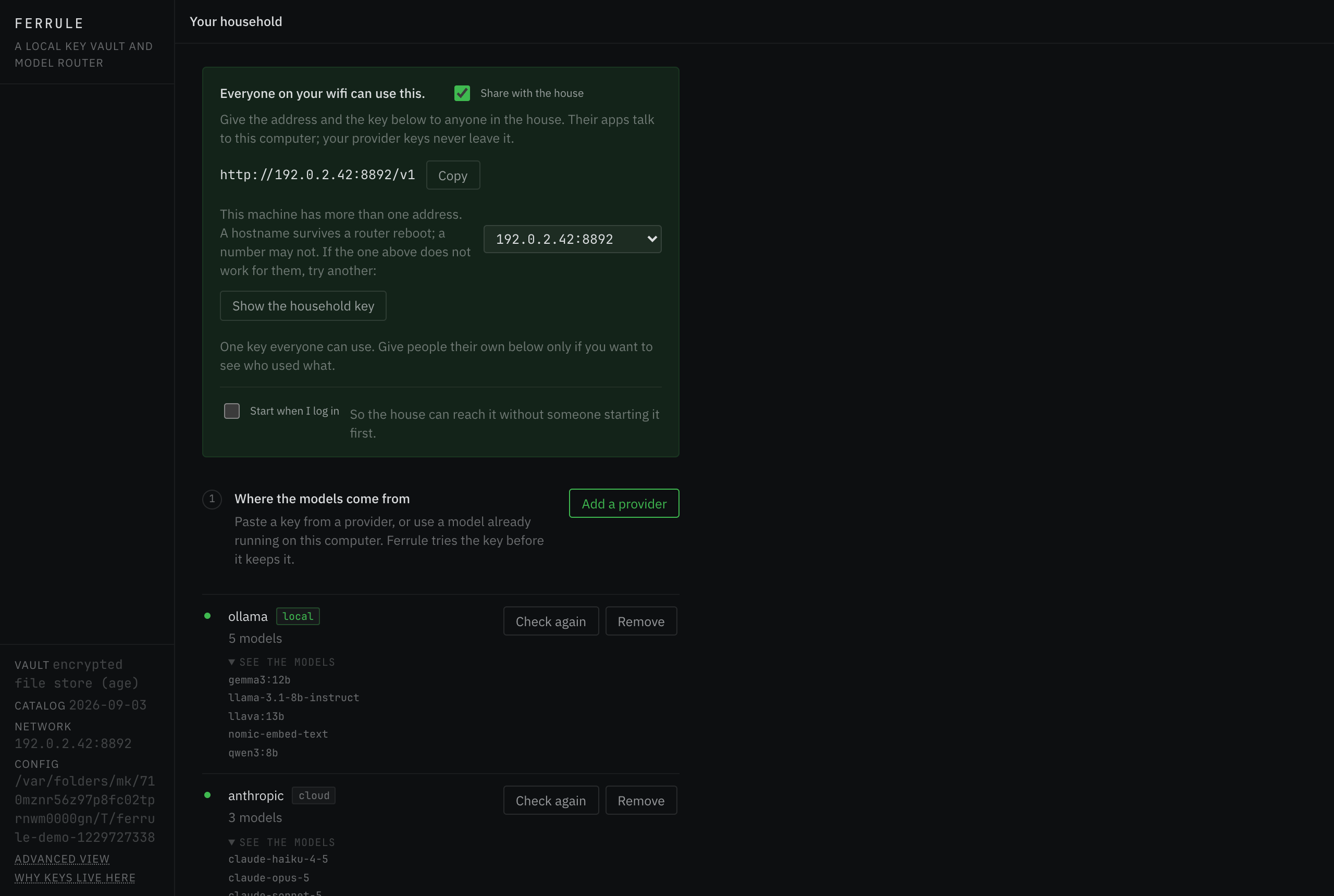
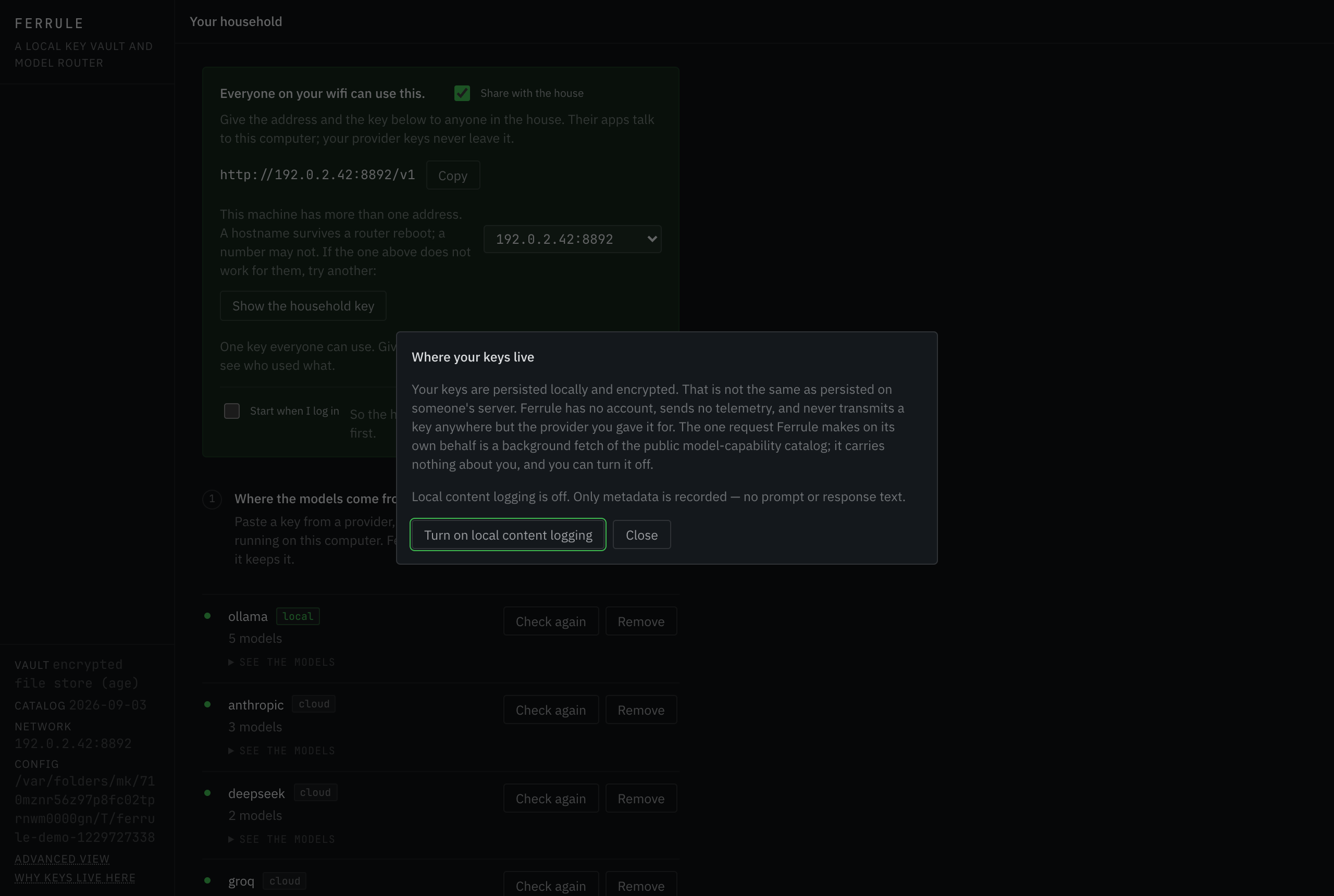
Your household
The simple view: what to hand out, and what Ferrule found.
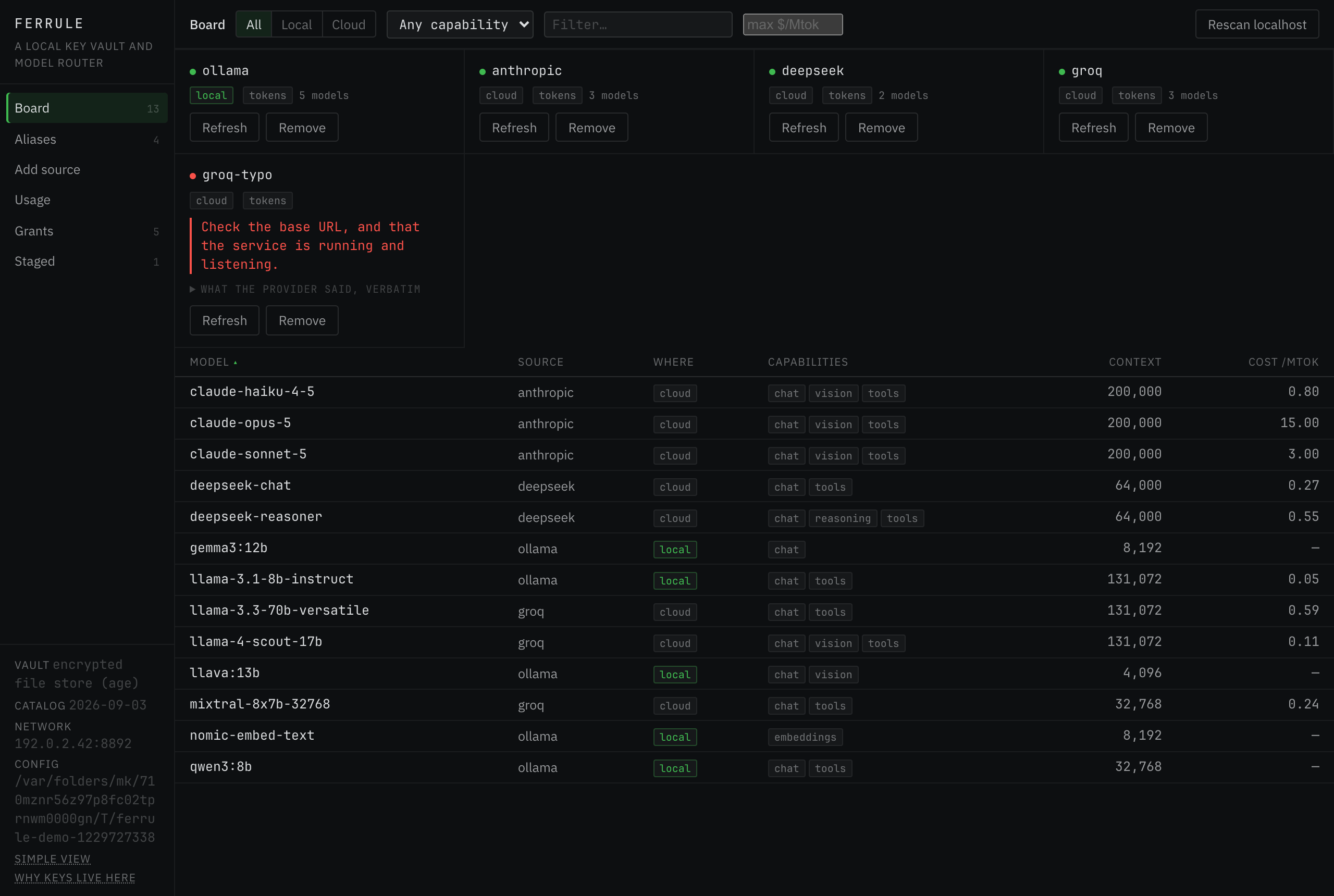
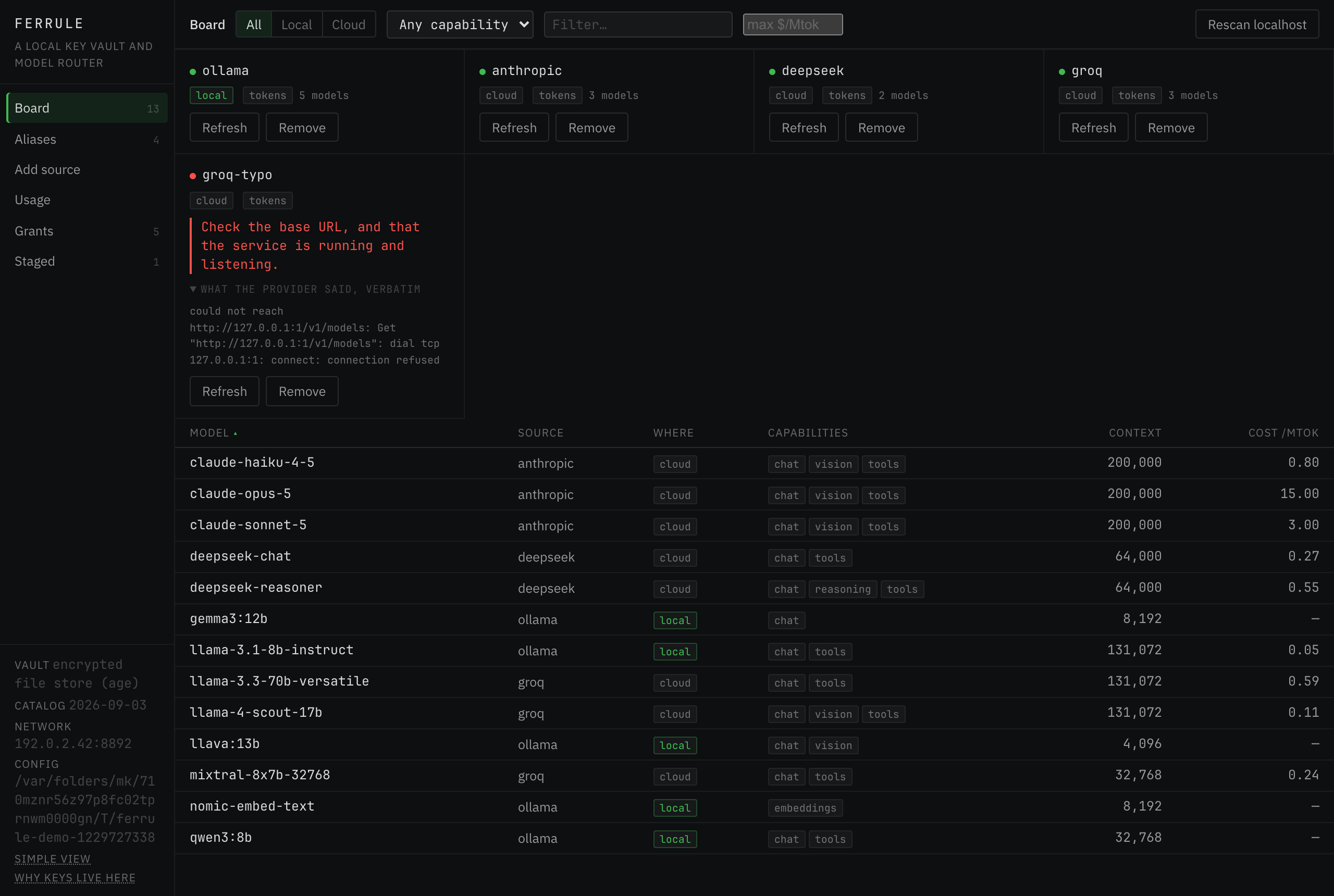
The board
The advanced view: every model, and the sources behind them.
Aliases and sources
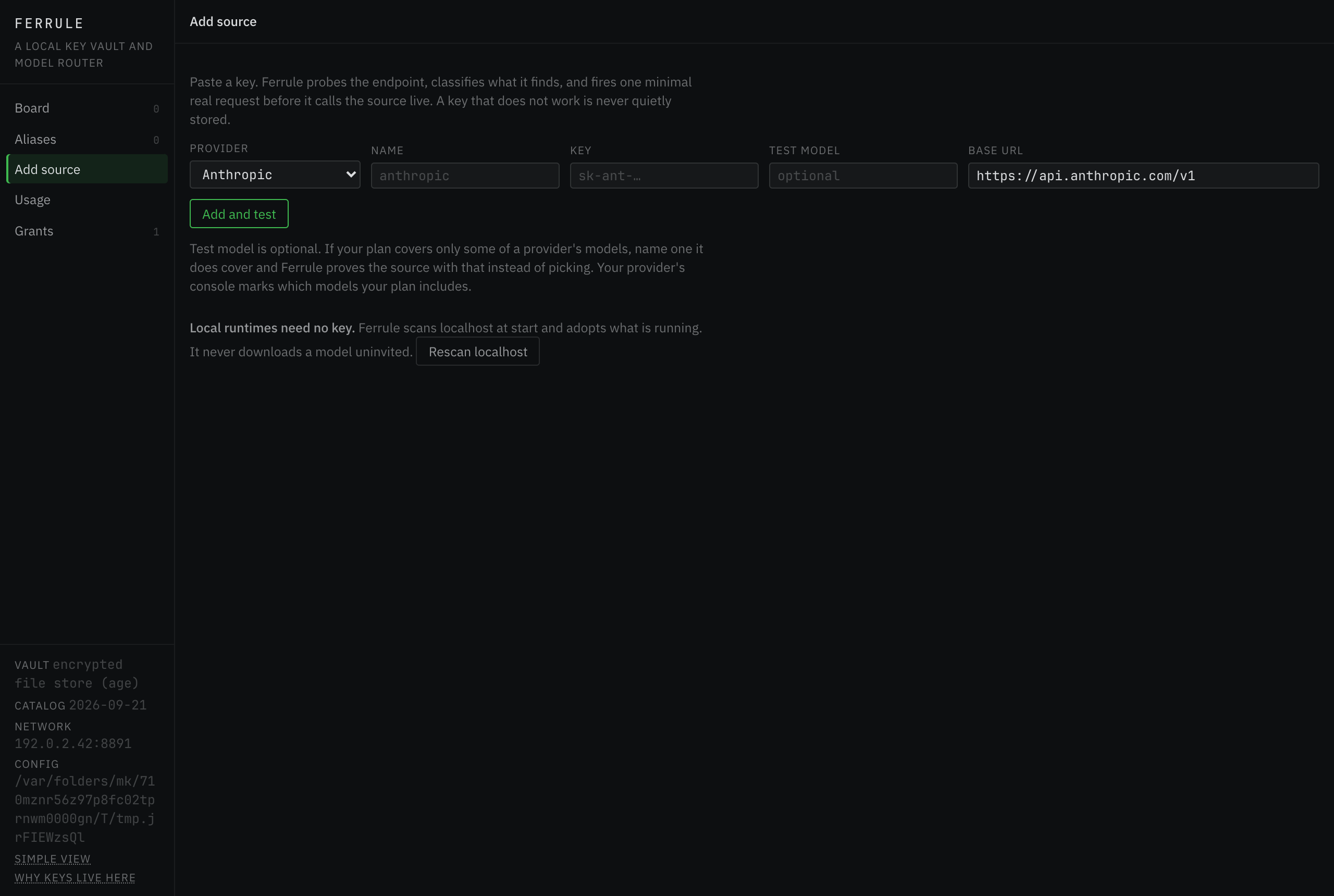
Names apps can ask for, and how a source is added.
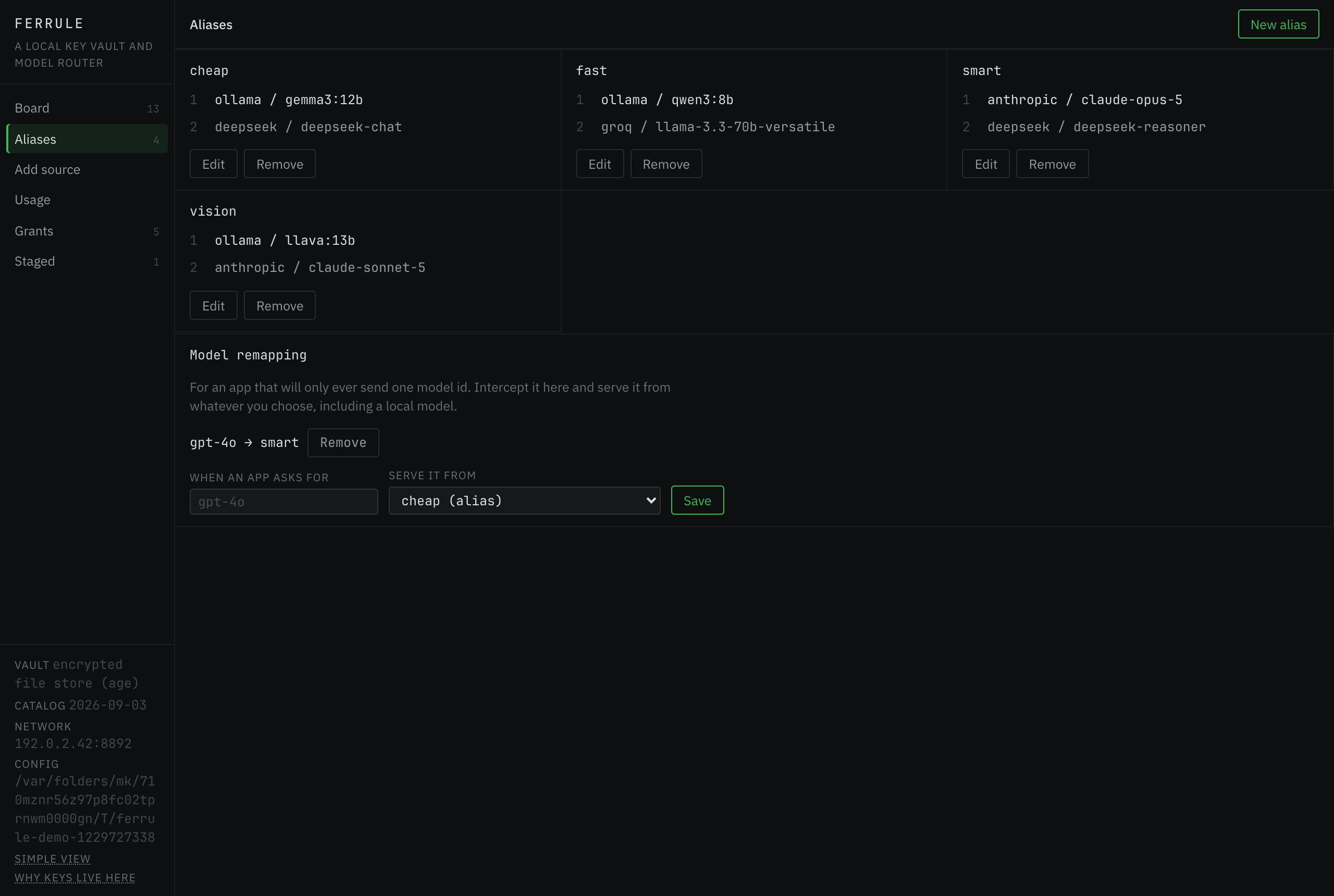
fast; you decide what fast means, and change it without telling anyone.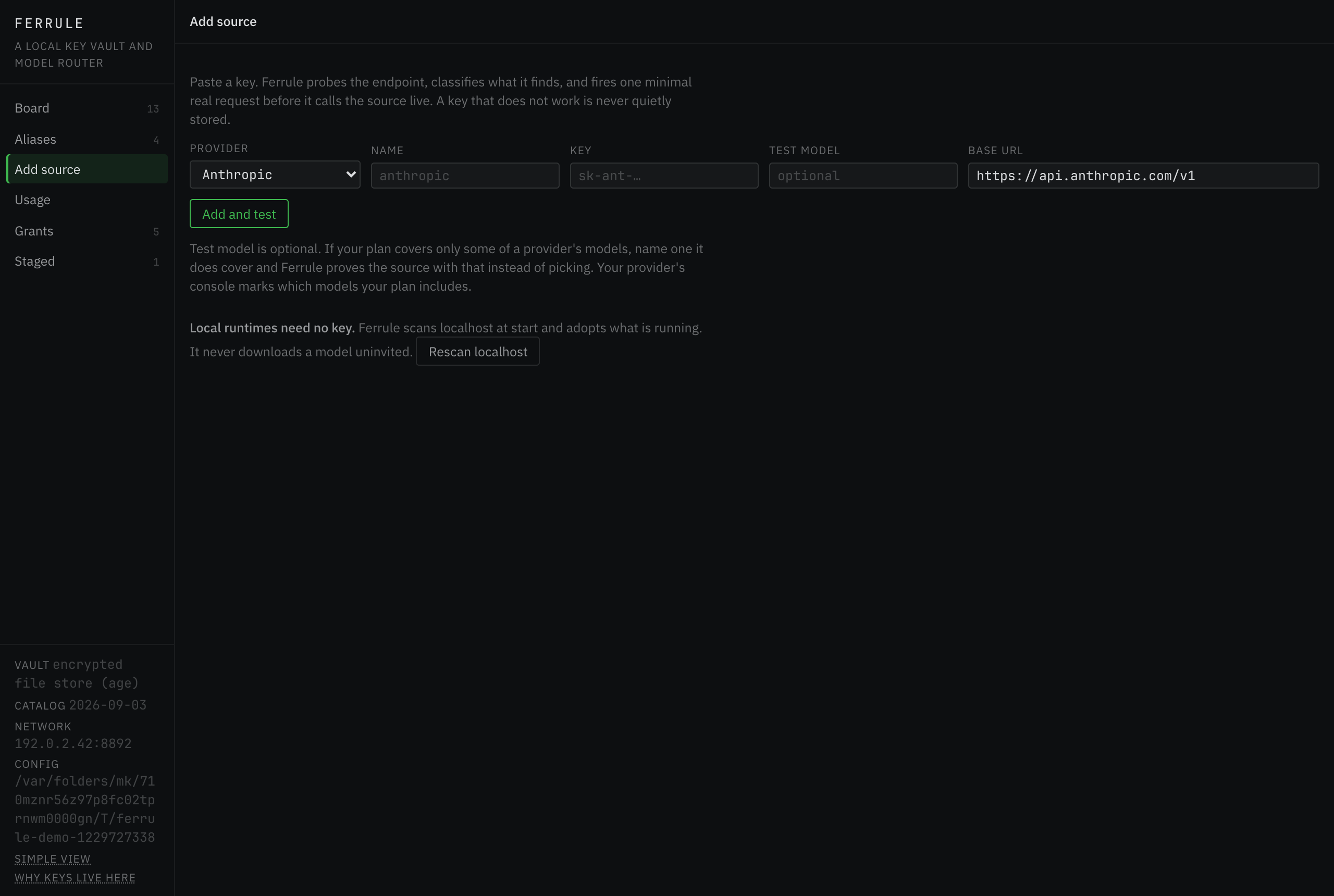
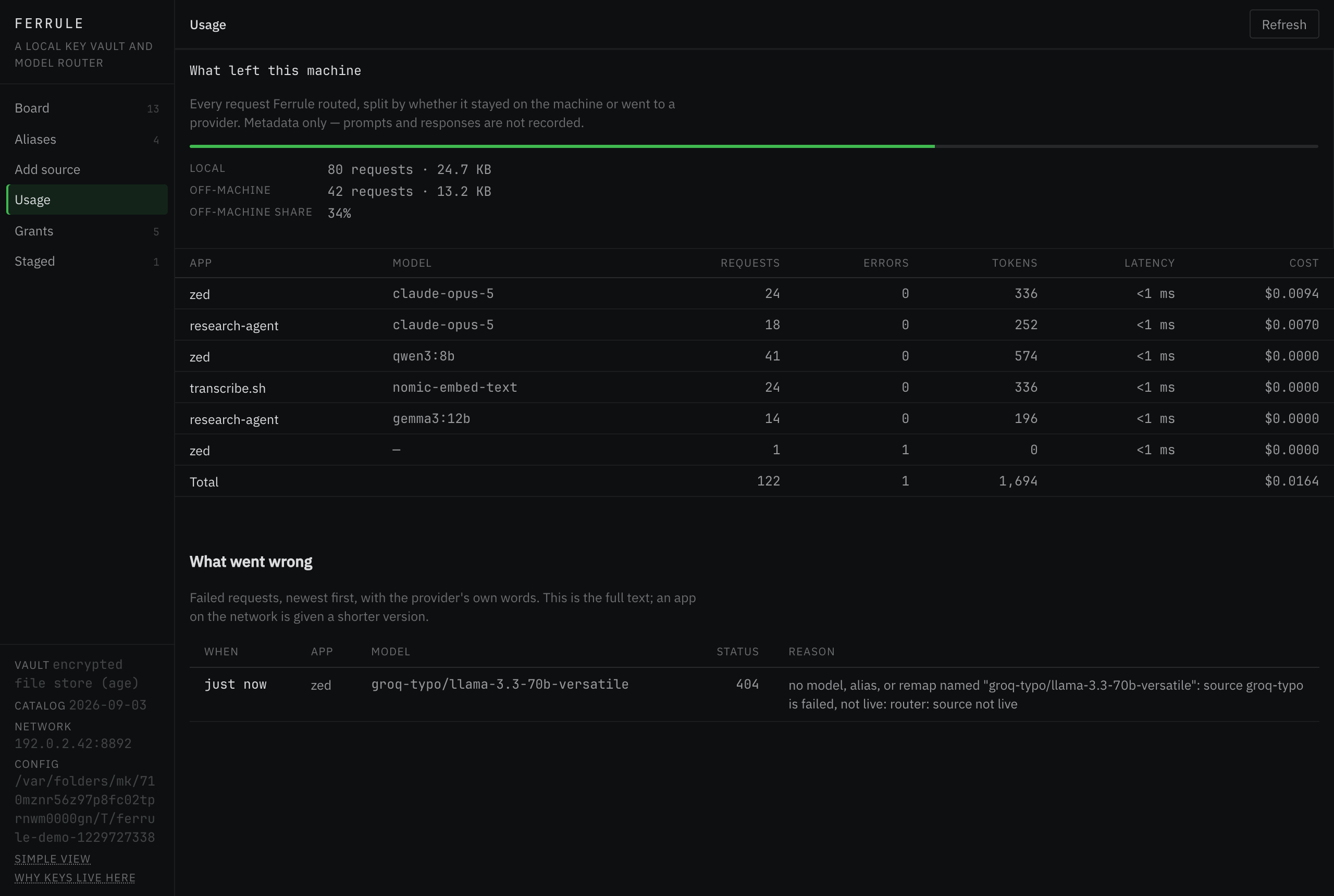
Usage
What it cost, where it went, what went wrong.
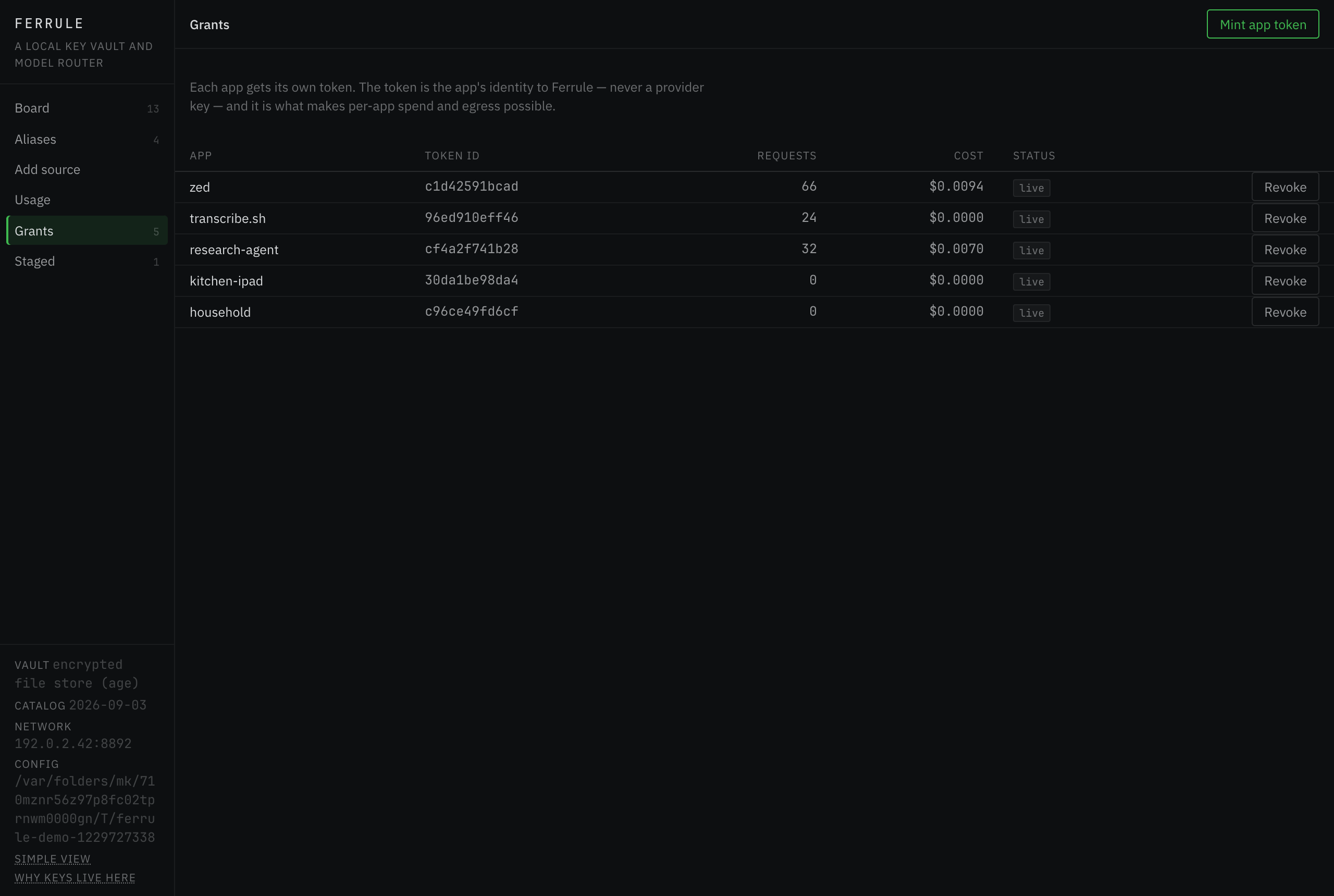
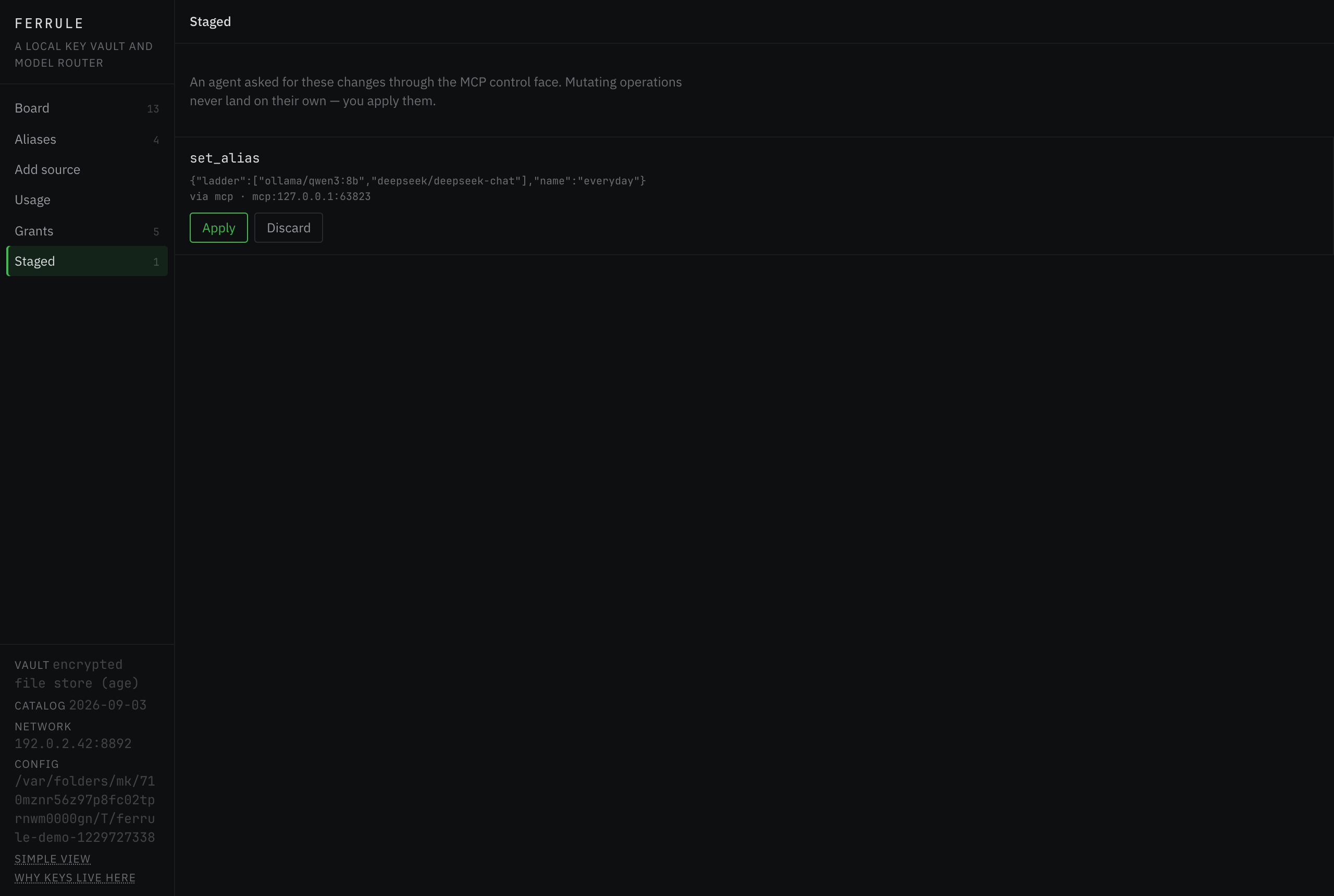
Grants and staged changes
Who holds a token; what an agent has proposed.
Someone in the house
A person on the wifi with the address and a key. They never see the panel; their app talks to the endpoint.
Using the endpoint
The OpenAI-compatible lane, with a Ferrule token.
$ curl -s http://127.0.0.1:8892/v1/models -H "Authorization: Bearer $FERRULE_KEY" | python3 -m json.tool | head -24
{
    "data": [
        {
            "ferrule": {
                "capabilities": [
                    "chat"
                ],
                "context_length": 8192,
                "source": "ollama",
                "where": "local"
            },
            "id": "gemma3:12b",
            "object": "model",
            "owned_by": "ollama"
        },
        {
            "ferrule": {
                "capabilities": [
                    "chat",
                    "tools"
                ],
                "context_length": 131072,
                "source": "ollama",
                "where": "local"
ferrule in each entry says where the model runs.$ curl -s http://127.0.0.1:8892/v1/chat/completions \ -H "Authorization: Bearer $FERRULE_KEY" -H 'Content-Type: application/json' \ -d '{"model":"fast","messages":[{"role":"user","content":"Say hello in five words."}]}' | python3 -m json.tool { "choices": [ { "finish_reason": "stop", "index": 0, "message": { "content": "ferrule routed this", "role": "assistant" } } ], "id": "chatcmpl-mock", "model": "qwen3:8b", "object": "chat.completion", "usage": { "completion_tokens": 3, "prompt_tokens": 11, "total_tokens": 14 } }
fast and the first reachable rung serves it — here a local model, so the request never left the machine.$ curl -s -i http://127.0.0.1:8892/v1/models | head -12 HTTP/1.1 401 Unauthorized Content-Type: application/json Date: Mon, 21 Sep 2026 16:27:53 GMT Content-Length: 134 {"error":{"code":401,"message":"missing Authorization header — pass a Ferrule app token as a Bearer token","type":"ferrule_error"}}
$ curl -s http://127.0.0.1:8892/v1/chat/completions \
  -H "Authorization: Bearer $FERRULE_KEY" -H 'Content-Type: application/json' \
  -d '{"model":"groq-typo/llama-3.3-70b-versatile","messages":[{"role":"user","content":"hi"}]}' | python3 -m json.tool
{
    "error": {
        "code": 404,
        "message": "no model, alias, or remap named \"groq-typo/llama-3.3-70b-versatile\": source groq-typo is failed, not live: router: source not live",
        "type": "ferrule_error"
    }
}
You, in the terminal
Every panel operation is also a verb. The CLI reads and writes the same state the daemon serves.
Reading the state
Status, models, aliases, usage.
$ ferrule --help
ferrule — a local key vault and model router

Verbs:
  status   the whole situation in one read (--json for an agent)
  serve    start the daemon (endpoints + control surface)
  open     make sure it is running, then show the panel
  startup  start Ferrule when you log in (on | off)
  add      add a source (paste a key, or adopt a detected runtime)
  ls       list sources / models / aliases
  refresh  re-check a stored source, using the key it already holds
  rm       remove a source, its models, and its key
  alias    create, edit, or remove an alias
  remap    serve a hardcoded model id from a model of your choosing
  key      mint or revoke an app token
  usage    per-app and per-model spend, volume, and egress
  export   write a portable encrypted configuration file
  import   read a portable encrypted configuration file
  version  print the version

Exit codes: 0 the thing worked · 1 it did not, and the reason says why · 2 the
command was wrong.
$ ferrule status
ferrule dev · http://127.0.0.1:8892/v1

SOURCE     WHERE  LANE    STATUS  DETAIL
ollama     local  tokens  live
anthropic  cloud  tokens  live
deepseek   cloud  tokens  live
groq       cloud  tokens  live
groq-typo  cloud  tokens  failed  unreachable · could not reach http://127.0.0.1:1/v1/models: Get "http://127.0.0.1:1/v1/models": dial tcp…

13 model(s) servable — 5 local, 8 cloud
  chat 12 · embeddings 1 · reasoning 1 · tools 10 · vision 5

ALIAS   RUNGS  SERVING
cheap   2      ollama/gemma3:12b
fast    2      ollama/qwen3:8b
smart   2      anthropic/claude-opus-5
vision  2      ollama/llava:13b

3 app token(s), 3 live · last 24h: 78 local, 42 off-machine
vault encrypted file store (age) · catalog 2026-09-03 (stale)

next:
  groq-typo — could not reach http://127.0.0.1:1/v1/models: Get "http://127.0.0.1:1/v1/models": dial tcp 127.0.0.1:1: connect: connection refused  ·  Check the base URL, and that the service is running and listening.
  The capability catalog has not refreshed in over a day. Costs and context lengths may be behind.
next: list of anything that needs you. --json for an agent.$ ferrule ls models MODEL SOURCE WHERE CAPABILITIES CONTEXT IN $/M OUT $/M claude-haiku-4-5 anthropic cloud chat,vision,tools 200000 0.80 4.00 claude-opus-5 anthropic cloud chat,vision,tools 200000 15.00 75.00 claude-sonnet-5 anthropic cloud chat,vision,tools 200000 3.00 15.00 deepseek-chat deepseek cloud chat,tools 64000 0.27 1.10 deepseek-reasoner deepseek cloud chat,reasoning,tools 64000 0.55 2.19 gemma3:12b ollama local chat 8192 — — llama-3.1-8b-instruct ollama local chat,tools 131072 0.05 0.08 llama-3.3-70b-versatile groq cloud chat,tools 131072 0.59 0.79 llama-4-scout-17b groq cloud chat,vision,tools 131072 0.11 0.34 llava:13b ollama local chat,vision 4096 — — mixtral-8x7b-32768 groq cloud chat,tools 32768 0.24 0.24 nomic-embed-text ollama local embeddings 8192 — — qwen3:8b ollama local chat,tools 32768 — —
$ ferrule ls models --local
MODEL                  SOURCE  WHERE  CAPABILITIES  CONTEXT  IN $/M  OUT $/M
gemma3:12b             ollama  local  chat          8192     —       —
llama-3.1-8b-instruct  ollama  local  chat,tools    131072   0.05    0.08
llava:13b              ollama  local  chat,vision   4096     —       —
nomic-embed-text       ollama  local  embeddings    8192     —       —
qwen3:8b               ollama  local  chat,tools    32768    —       —
--local narrows to models on this machine — the ones whose requests never leave it.$ ferrule alias ALIAS LADDER cheap ollama/gemma3:12b → deepseek/deepseek-chat fast ollama/qwen3:8b → groq/llama-3.3-70b-versatile smart anthropic/claude-opus-5 → deepseek/deepseek-reasoner vision ollama/llava:13b → anthropic/claude-sonnet-5
ferrule alias <name> <src>/<model> … sets one.$ ferrule usage GROUP REQUESTS ERRORS TOKENS LATENCY COST zed / claude-opus-5 24 0 336 0ms $0.0094 research-agent / claude-opus-5 18 0 252 0ms $0.0070 zed / qwen3:8b 40 0 560 0ms $0.0000 transcribe.sh / nomic-embed-text 24 0 336 0ms $0.0000 research-agent / gemma3:12b 14 0 196 0ms $0.0000 Total 120 $0.0164
$ ferrule usage --egress
WHERE        REQUESTS  BYTES
local        78        24854
off-machine  42        13566

off-machine share  35%
Minting a key
One token per person or app.
$ ferrule key kitchen-ipad
Minted app token for "kitchen-ipad". This is shown once:

  frl_fKSbN3RRarBseWtNHBx404j8_K4RnMqc

Point the app at http://127.0.0.1:8892/v1 with this as its API key.
A coding agent
The agent face: llms.txt and an MCP manifest served by the daemon. Proposals stage; you apply.
Driving Ferrule from an agent
Read the surface, then propose.
$ curl -s http://127.0.0.1:8892/llms.txt | head -30
# Ferrule

> A local key vault for LLM provider keys, with an OpenAI-compatible router in front of
> it. One Go binary. Keys are encrypted on the user's own disk; nothing is hosted.

Ferrule is a **key vault first, a router second**. A person pastes a provider key once;
Ferrule becomes the single encrypted local home for it. The unified endpoint, the model
board, the alias ladders, and the spend/egress views all fall out of that.

If you are an agent driving Ferrule, read this file and then call `brief`. Do not explore.

## Two things it does that alternatives do not

- **Zero-config discovery.** No config file. It scans localhost for running runtimes
  (Ollama, LM Studio, llama.cpp) and adopts them; a cloud provider is *paste a key*.
- **Egress visibility.** A local, metadata-only ledger of what actually left the machine,
  per app and per model — classified from the address the connection was made to.

## The three faces (they do not overlap)

| Face | Path | Auth |
|---|---|---|
| Inference — raw tokens | `/v1/chat/completions`, `/v1/completions`, `/v1/embeddings`, `/v1/images/generations`, `/v1/models` | Ferrule app token, Bearer |
| Inference — media passthrough | `/p/<source>/…`, provider's native shape, bytes unaltered | Ferrule app token |
| Control | `/api/op/<name>`, `/mcp` | localhost + a per-run control token |

The control face is **not** an inference path. Your own inference goes through the
OpenAI-compatible endpoint like any other client.

## Driving inference
llms.txt: what Ferrule is and how to drive it, so an agent pointed at a live Ferrule gets the surface without the repo.$ curl -s http://127.0.0.1:8892/mcp | python3 -c 'import json,sys; m=json.load(sys.stdin); print(m["instructions"]); print(); [print(" "+t["name"].ljust(18), t["description"][:80]) for t in m["tools"]]' Ferrule's control plane. Read ops answer immediately. Mutating ops are staged and land only when the person applies them. Person-only ops cannot be delegated. Inference does not go through here: point your client at the OpenAI-compatible endpoint with a Ferrule app token. add_source Add a source: paste a key for a known provider, or a key and base URL for an unk brief The whole situation in one bounded read: sources and why any are dark, what the catalog_refresh Refresh the capability catalog from its maintained source now. detect_local Scan localhost for known runtimes and adopt what is running. egress_summary What left the machine, and what stayed on it. export_config Write a portable encrypted configuration file, sealed under a passphrase so the forget_content Delete everything the content log holds. get_alias Read one alias and its fallback ladder. household_key Read the key the whole household shares. Person-only: it returns a live credenti import_config Read a portable encrypted configuration file and merge it into local state — sou list_aliases List every alias and its fallback ladder. list_grants List app tokens and what each one spent. list_models List every model on every live source, with capability, context, and cost. list_remaps List every model-id remap. list_sources List every source, live and failed, with its reason. list_staged List control operations staged for a person to apply. mint_grant Mint an app token. Person-only: it returns a credential, shown once. read_content Read the local content log, when content logging is on. Person-only: it returns recent_errors The requests that failed, newest first, with what the provider actually said. refresh_source Re-probe a source and re-classify its models. regenerate_household_key Retire the household key and issue a new one. Every device using the old one sto remove_alias Delete an alias. remove_remap Delete a remap. remove_source Remove a source, its models, and its stored key. revoke_grant Revoke an app token. set_alias Point an alias at an ordered ladder of models. set_remap Serve a hardcoded model id from a model of your choosing. set_setting Change a Ferrule setting. set_share_address Choose which of this machine's addresses the household is given. set_startup Register or unregister the daemon with the login manager. Person-only: it writes status Ferrule's own state: version, config dir, vault backend, catalog date. usage_summary Spend, volume, latency, and errors, grouped as you ask.
$ curl -s -X POST http://127.0.0.1:8892/mcp -H 'Content-Type: application/json' -d '{
  "jsonrpc":"2.0","id":1,"method":"tools/call",
  "params":{"name":"set_alias","arguments":{"name":"everyday","ladder":["ollama/qwen3:8b","deepseek/deepseek-chat"]}}
}' | python3 -c 'import json,sys; print(json.load(sys.stdin)["result"]["content"][0]["text"])'
{
  "args": {
    "ladder": [
      "ollama/qwen3:8b",
      "deepseek/deepseek-chat"
    ],
    "name": "everyday"
  },
  "dropped_undeclared": null,
  "id": "76b5abea04e4",
  "message": "Staged set_alias — apply it in Ferrule to land the change.",
  "op": "set_alias",
  "staged": true,
  "withheld": null
}
Nothing matches.